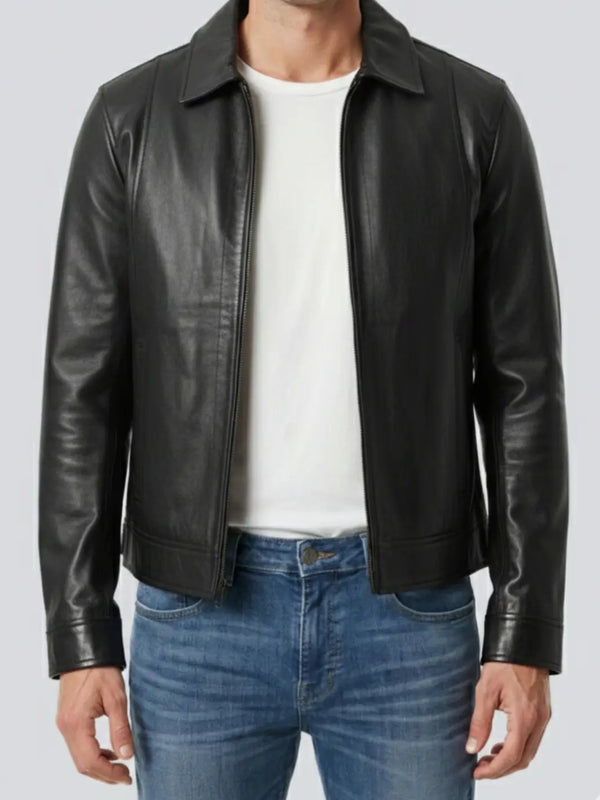
Best Men's Leather Jackets for European Winters: 2026 Buyer's Guide
European winters are not uniform, but they share common demands: wind resistance, water repellency for persistent drizzle, and the ability to layer for variable temperatures. Here is the complete guide to choosing the right leather jacket for European winter conditions.
European winters cover a significant range: Oslo in January is a different environment from Barcelona in December, and both differ from Amsterdam or Berlin in February. The right leather jacket for a European winter depends on where in Europe you are, how cold it actually gets, and how much of your warmth you plan to derive from the jacket itself versus layering beneath it. This guide addresses all three variables.
What European Winters Actually Demand from a Leather Jacket
The defining weather challenge across most of temperate Europe is not extreme cold but persistent damp cold combined with wind. Cities like London, Paris, Amsterdam, Brussels, and Hamburg regularly experience temperatures between 2 and 10 degrees Celsius through the winter months, almost always accompanied by wind and frequent rain. This combination exposes the specific properties that make a leather jacket more or less suited to European conditions.
Full-grain leather performs well in this environment for two reasons. First, its dense grain structure provides genuine wind resistance, which multiplies the warmth of any layers worn underneath. Second, its natural oil content provides meaningful water resistance for light rain and drizzle, which is the dominant precipitation type across northern and western Europe. For sustained heavy rain, a dedicated waterproof shell is more appropriate, but for the typical European urban winter day, a well-maintained full-grain leather jacket is a practical and effective outer layer.

The Best Leather Jacket Styles for European Winter Wear
1. The Leather Bomber
The leather bomber jacket is the most practical choice for European urban winter wear. Its ribbed knit at the cuffs and hem seals wind at the wrists and waist, its cropped length allows freedom of movement on public transport and in urban environments, and it layers effectively over a heavy knit or thermal base for temperatures approaching zero. The men's leather bomber collection at Decrum uses full-grain lambskin at 0.6 to 0.8mm, which provides the wind resistance of heavier leather without the bulk that makes movement uncomfortable in city conditions.
2. The Leather Biker Jacket
The leather biker jacket provides more coverage than a bomber, with the asymmetric zip closure and snap collar offering additional wind protection at the chest and neck. For cities with sustained cold spells (Munich, Vienna, Warsaw in January and February), the biker jacket's additional structure provides meaningful extra warmth over a mid-weight knit. Its longer front zip creates better wind sealing than many bomber closures.
3. The Leather Coat or Long Jacket
For the coldest European climates (Scandinavia, northern Germany, Poland, the Baltic states), a longer leather coat provides significantly more coverage than a jacket-length option. Full-length or three-quarter leather coats worn over a wool mid-layer provide warmth that approaches a dedicated winter coat while retaining the material properties of leather.

Layering System for European Winter Temperatures
For temperatures between 5 and 10 degrees Celsius (most of western Europe, most of the winter): a leather bomber or biker jacket over a mid-weight crew-neck knit and a fitted base layer. This combination is comfortable for most western European urban winter conditions.
For temperatures between 0 and 5 degrees Celsius (central Europe in winter, northern UK): add a heavier wool knit beneath the leather jacket and a thermal base layer. The leather jacket's wind resistance means this combination performs well above its apparent insulation rating in the exposed street conditions of European cities.
For temperatures consistently below zero (Scandinavia, eastern Europe in winter): size up one in the leather jacket to accommodate a thick wool mid-layer, add a thermal base, and supplement with a scarf and gloves. The leather jacket functions as a wind-blocking outer shell in this system rather than a primary insulator.

Material Specification: What to Look for
For European winter use, the minimum specification is full-grain leather at 0.8mm or above. Top-grain or genuine leather lacks the density of full-grain and provides less wind resistance. Bonded leather performs poorly in damp cold conditions, deteriorating faster and providing minimal weather resistance. See our detailed guide on full-grain vs top-grain leather for the specific differences that matter for performance in cold, damp conditions.
Lambskin is lighter and more supple than cowhide at equivalent thickness, making it more comfortable for daily urban wear in European cities. Cowhide provides more abrasion resistance but is heavier. For city winter wear rather than outdoor or motorcycling use, lambskin is the more appropriate choice.

Edinburgh Dark Brown Hooded Jacket
Full-grain lambskin with a removable hood. Wind-blocking and warm for European winters.
Shop Now
Bryan Black Lambskin Bomber
Clean, minimal full-grain lambskin. Versatile across every European climate.
Shop NowColour for European Winter: What Works
Black is the most practical colour for European urban winter wear. It works with the dark palette of typical winter dressing, does not show rain marks as visibly as lighter colours, and reads as appropriately urban across every major European city. Dark brown and cognac are strong alternatives that create a warmer visual register appropriate for the autumn-winter season. Tan and lighter tones require more maintenance in damp conditions and can show water marks more visibly.
Full-grain leather at 0.8mm or above, in a bomber or biker silhouette, over a mid-weight wool knit and thermal base, with a scarf and gloves as temperatures drop below 5 degrees Celsius. This combination handles the wind and damp cold of most European cities effectively across the winter months.
Frequently Asked Questions
Helpful leather guides: the leather jacket buying guide · types of leather · how to choose the right size · leather jacket care guide · how to tell if leather is real